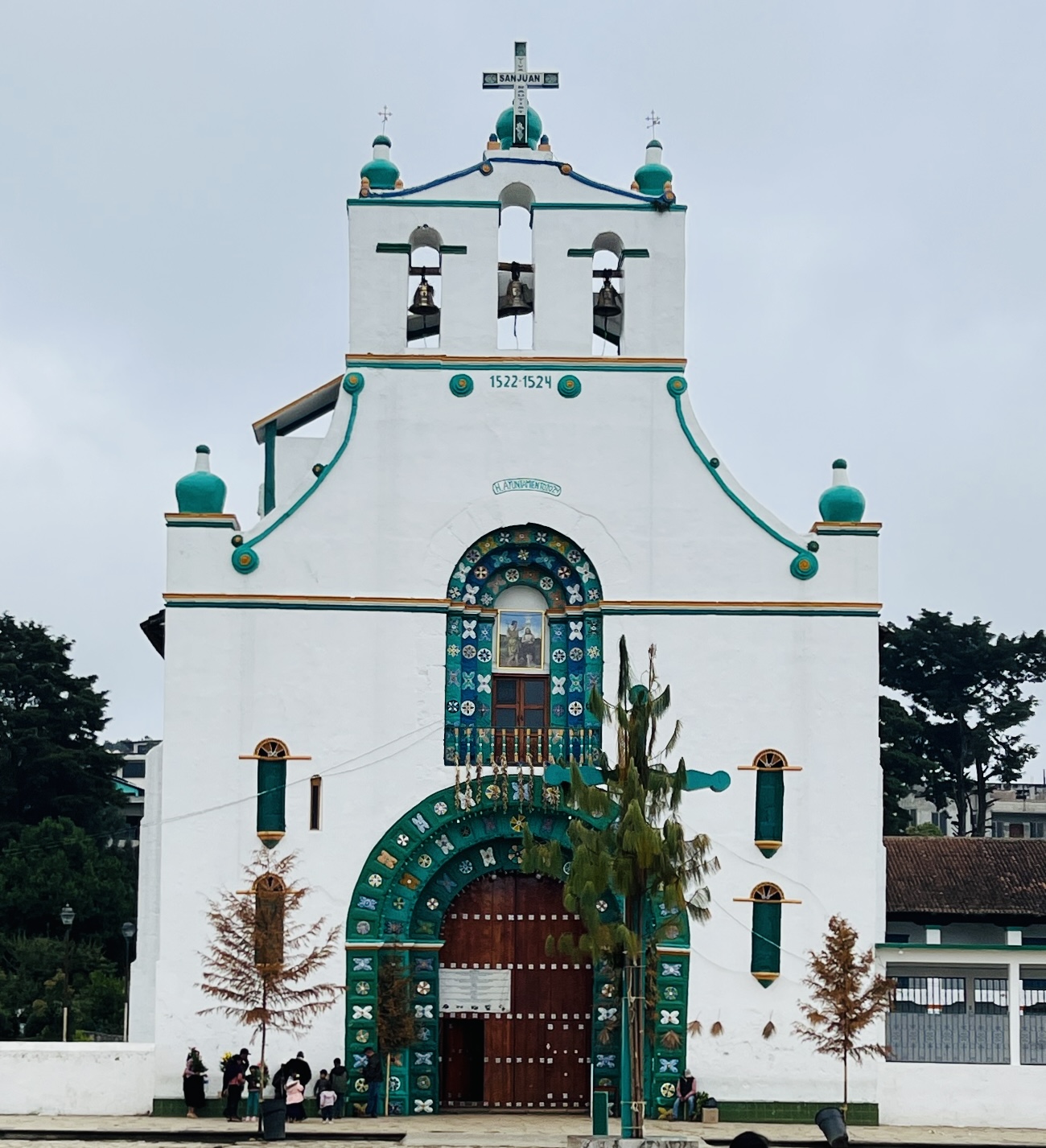
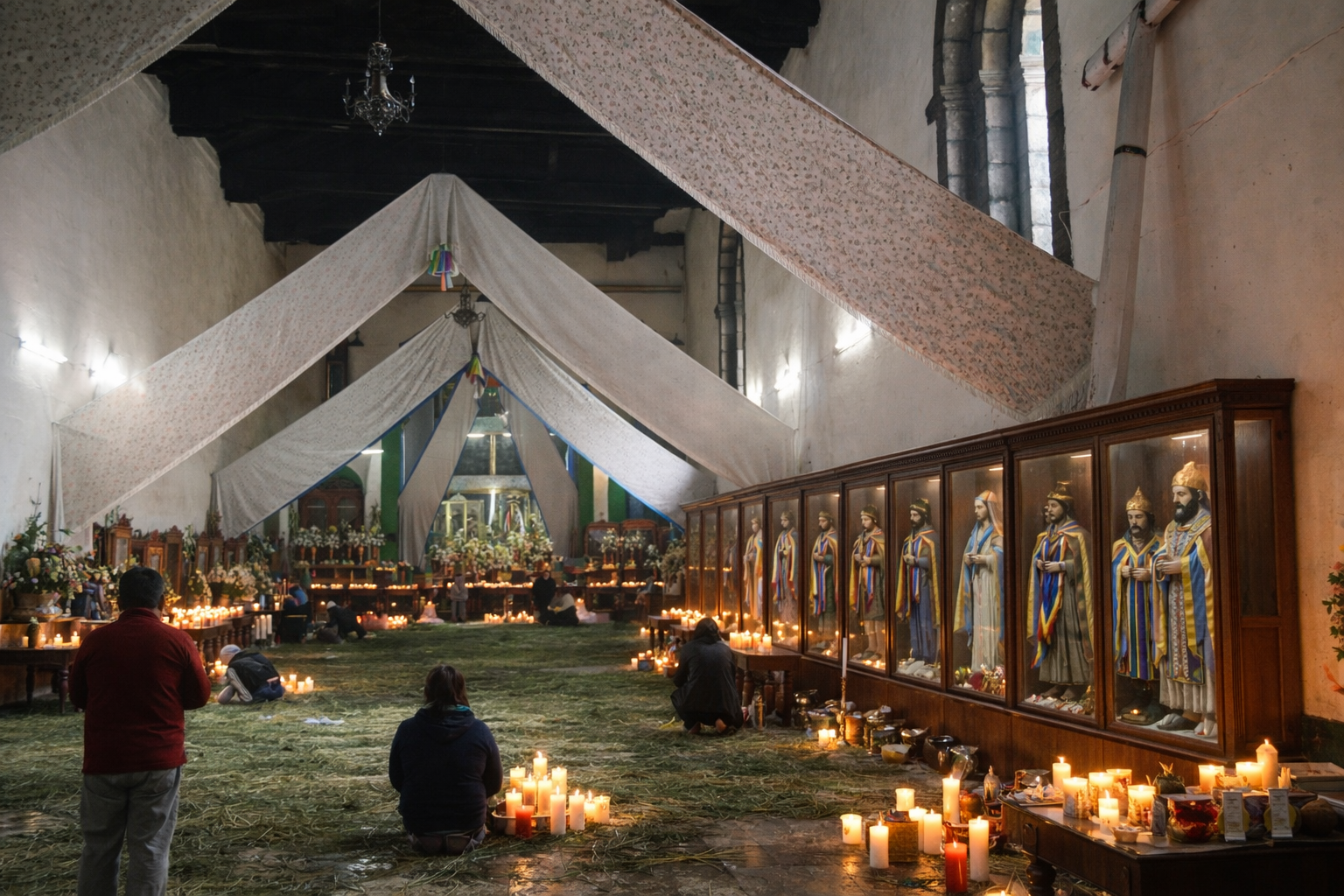
The moment I stepped through the doors of the church in San Juan Chamula, the air seemed to close in around me — copal incense, and the heat and smoke rising from thousands of candles. It felt as if my breath might stop, confronted by a scene I could never have imagined. Unlike the Catholic churches I’ve known, there were no pews. The floor was thickly carpeted with pine needles. Members of the Tzotzil Maya community sat on the ground, murmuring prayers in low voices. Through the dense candle smoke, statues of saints and images of the Virgin stood in rows inside glass-fronted display cases along the walls. What were they praying for so desperately?
The patron of Chamula Church: St John the Baptist
San Juan Chamula Church is, as its name suggests, dedicated to St John the Baptist (San Juan Bautista). Gabriella told me that the Chamula community honours St John the Baptist even more especially than Jesus Christ. Perhaps that is why the church’s central story seems to gather, quite naturally, around his name.
St John the Baptist is a saint of water and repentance — a figure who stands on the threshold of a new beginning. In Chamula, where ancient Indigenous traditions and Catholic devotion overlap within the same space, he can feel all the more like a guardian of the boundary. Inside the church, I found myself thinking: for the people here, St John the Baptist is not merely a figure from Scripture, but something closer to a patron saint who still watches over the village.
Saints behind glass, and what the mirrors might mean
Most of the statues in Chamula Church are housed in wooden cases with glass doors, lined up along the walls. Around them you can also see mirror decorations. The mirrors are ornamental, but they also seem to act as a kind of barrier — something that “wards off”. Some explanations even suggest they are meant to repel evil. Sitting before these cases, lighting candles, and performing prayer less as a recitation than as a lived ritual — the scene makes the whole church feel like one vast altar.
In front of some saints, offerings were abundant: flowers, ribbons, and gifts piled high. In front of others, there was far less, as if they had been quietly pushed back to the rear. The saints draped in vividly coloured ribbons — colours that reminded me of Korea’s traditional five-direction palette — looked nothing like the holy images I had known. For a moment, they brought to mind the ‘adorned spirit figures’ I’ve seen in Korean shamanic rites. Of course, I don’t mean they are the same. Rather, prayer here continues in a form shaped by the meeting of Tzotzil Maya Indigenous tradition and Catholic devotion, and that meeting seems to show itself with striking clarity.
Perhaps that is why the statues did not feel like mere decoration or carving. They felt like beings who still receive people’s worries and wishes at close range. The distance between a saint covered in flowers and a saint left almost bare seemed to reveal something about the “relationships” within faith here.
Saints who receive flowers: a place of response
The saints in Chamula Church are placed in glass-fronted cases along the walls. Before them, people kneel, set candles alight, and pray with their own circumstances held in their hands. The scene was deeply unfamiliar — and yet, in the way they prayed, there was unmistakable reverence.
Perhaps that is why devotion to particular saints appears in such a tangible way. Before a saint believed to “answer prayers well”, more candles gather, more flowers and ribbons are added, and offerings increase. In other words, the saints do not feel distant. They seem to be remembered within daily life as the “response” to prayer.
Saints pushed back: the story of “punished saints”
Gabriella also told me about what people call santos castigados — “punished saints”.
The story goes like this. A saint believed to answer prayers is moved to a better position and receives richer adornment. But if someone feels a saint has not listened — if they believe their prayer was not answered — that saint may gradually be moved further back, or their decorations may diminish, treated as if they have been castigado: punished or reprimanded.
Hearing this, I was briefly taken aback. If Catholic faith speaks of unconditional love and mercy, then the devotion I encountered in Chamula felt, in some ways, like a relationship — something “tested” and “judged”. And yet, precisely because it was so human, it also felt raw — and strangely truthful. The saints here seemed less like figures that offer comfort alone, and more like presences that carry, together with the people, the weight of life and promises made.
St Sebastian and St Peter: two other pillars of the village
If you follow the threads of Chamula’s traditions and religious festivals, you often come across the names St Sebastian (San Sebastián) and St Peter (San Pedro). Their names, too, hint at how the community has sustained its own religious rhythm around multiple saints.
To a traveller, these might look like nothing more than a “list of saints inside the church”. But to a pilgrim’s heart, they arrive differently. Whom we ask, and what we ask for, is bound up with what we are holding most tightly — most desperately — in our own lives. So I remember less the names themselves, and more the speed at which the candles burned, and the expression of silence that seemed to pass across that space.
About St Sebastian, there is a story people tell. After the old Church of St Sebastian burned or collapsed, the statues that had been there were moved to Chamula’s main church. And then, the tale continues, they were “punished” for failing to protect their church — placed facing the wall. Fact and legend blur here, but the story itself left me with the sense that saints in Chamula are not simply objects; they are living parts of a community’s memory.
In the Catholic world, St Peter is famously associated with “keys”. Yet in Chamula Church, what mattered more than symbolism was the number of candles before me, and the place where prayer was being laid down. Looking at St Peter, I found myself thinking this: the key that opens a door is not only in a saint’s hand — it is also in the time of the person who keeps praying, refusing to let go.
The Virgin Mary: not one, but “many forms” close at hand
Gabriella explained that people often speak not only of saints but also of “virgins” — images of the Virgin Mary. Of the Virgins present, she described one newly installed image as a “learning” Virgin. It sounded to me as though this connects to the way saints here are sometimes understood by rank or status — “greater/smaller”, or “older/newer”. Perhaps for that reason, Mary is not spoken of as a single figure alone, but as a presence set near the community’s life in several forms.
I was simply astonished: she looked so different from the images of Mary I had known. And yet, in this space, she felt like a “quiet centre”. Even in a sea of candles and incense smoke, she did not feel loud or dramatic — only close to people’s lives, close to their concerns. Like a mother who supports prayer at its weakest point, so that it does not break.
Closing
Saints who draw flowers, saints before whom candles gather, and saints quietly pushed back. Here, faith felt less like doctrine arranged in the mind, and more like something pressed into the body — through heat, smoke, and the weight of prayer.
If I return to this church one day, I suspect I won’t try to memorise the saints’ names more precisely. I will remember instead which candles trembled the longest — and before which saint. (Photography inside the church is forbidden, so take it in with your eyes alone.)
On a pilgrimage path towards my mother, now a star
– Little Star
#CatholicSaints #CandlePrayers #CopalIncense #copal #IndigenousTradition #SyncreticFaith #Tzotzil #MayaCulture #SeaOfCandles #NoPhotography #MexicanCulture
'성지순례 삼만리 여정 > 교회_Church' 카테고리의 다른 글
| 벨기에 브뤼헤 성모교회(Church of Our Lady) (2) | 2026.03.26 |
|---|---|
| 브뤼헤 성모교회와 부르고뉴 가문의 무덤 (0) | 2026.03.09 |
| 차물라 성당의 비밀, 꽃을 받는 성인과 밀려난 성인들. (0) | 2026.03.05 |
| 할그림스키르캬(Hallgrímskirkja) — 현무암 파이프가 하늘로 솟는 순간 (0) | 2026.03.04 |
| 공중 교회 — 이집트의 가장 오래된 기독교 예배당 (4) | 2026.03.03 |


