They say the Salt Cathedral was carved from “700-million-year-old salt,” and there wasn’t a single spectacle I could leave out. The monumental crosses stood in the darkness with an overwhelming presence, and the moment I faced them it felt as if my breath stopped for a beat. Yet, after all that awe, the place that held me the longest was a pool deep underground—about 180 metres down (some sources even describe it as 200 metres). Isn’t this exactly what a hidden, sacred and mysterious space looks like?
The Water Mirror (Water Mirror, Espejo de Agua)
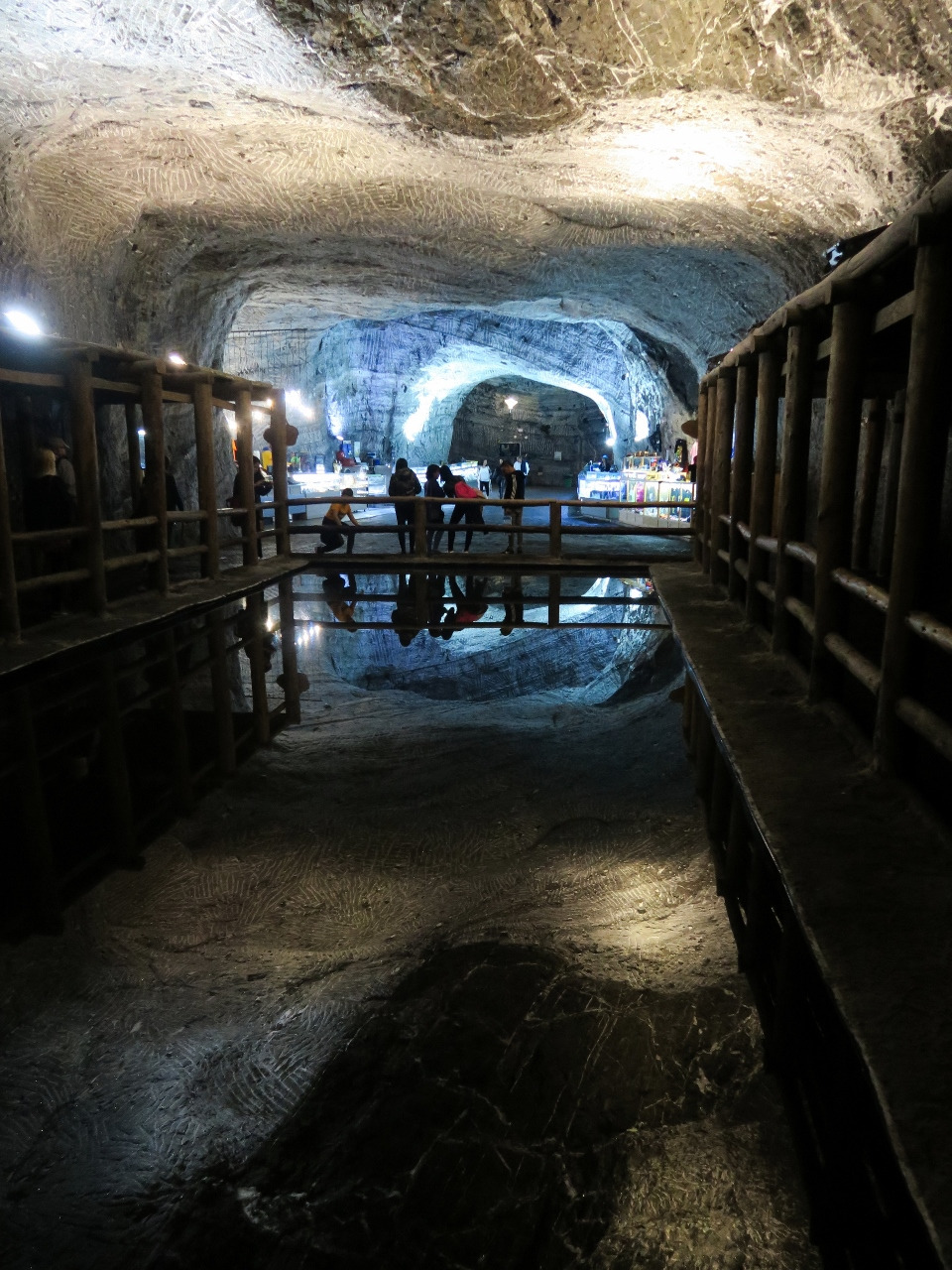
People call this place the “Water Mirror”. In the stillness underground, when the water reflects the ceiling and the walls as if it were unveiling a second world, I felt as though I’d stepped into another dimension. It was so uncanny that I stayed there for ages, almost as if I were meditating. It made me realise anew that salt is not merely a seasoning—depending on where you are, it can be regarded as a “sacred resource”.
The secret of the Water Mirror
This salt pond is not simply water; it is filled with brine—salt dissolved in water. With the lighting, the brine reflects the salt rock like a “perfect mirror”, creating an optical effect that makes the space feel deeper than it really is. I also found it fascinating that the brine’s concentration is explained in quite specific terms.
Perhaps that is why, standing before the pond, it felt like I was looking not at a single scene but at a space layered twice over. The stillness beneath my feet seemed to rise to the ceiling, and the texture of the ceiling seemed to drift back down to my feet. The photographs turn out beautifully not only because it is visually striking, but because the mystery has been carefully designed.
How did salt become a “sacred resource”?
The Water Mirror felt even more special once I learned that, in this region, salt has long been an exceptionally important resource. Before the Spanish conquest, the Muisca people mined and traded salt around Zipaquirá, Nemocón and Tausa, building prosperity—so much so that they are sometimes described as “people of salt”.
There is also a legend-like story that is often added. It is said that a child once happened to taste a “salty stone” and, through that moment, the presence of salt was revealed. This is less a precise historical record than a way of remembering salt not as something merely “discovered”, but almost as a “gift”. In that sense, salt can feel like more than a material of everyday life—something that fed communities and opened roads, a resource with a sacred weight to it.
Standing in front of the Water Mirror, I found myself recalling that tale. “Purification” may sound like a grand word, but this pond truly felt as though it was quietly rinsing away the turmoil of my mind.
The moment an underground pond becomes a pilgrimage site
The Salt Cathedral is an underground church created within the tunnels of a salt mine, and many people visit it as a place of pilgrimage.
After passing through the long corridors and the Stations of the Cross (fourteen in total), the atmosphere changes the moment you reach the Water Mirror. The silence grows thicker, as though another layer has been added, and the reflected ceiling opens out once more like a sky. In that instant, the exact depth no longer mattered. All that remained was the sensation: “Ah—down here, deep inside the earth, I am looking at a sacred light.”
Perhaps even the imagination of an “afterlife” is simply the language of the heart, naturally summoned by the illusion and the hush this place creates. The pinnacle of this salt-built underworld was not splendour after all, but stillness.
I did not manage to pray the Stations of the Cross (fourteen) all the way through on this visit, but if you come as a pilgrim, I hope you will follow this path slowly, praying as you go.
The full story of the Salt Cathedral continues in the post below.
The Cathedral Made of 700-Million-Year-Old Salt: https://stella-mum.tistory.com/303
On a pilgrimage path towards my mother, now a star
– Little Star
#Colombia #Zipaquirá #SaltCathedral #CatedralDeSal #SaltPond #WaterMirror #EspejoDeAgua #Brine #Muisca #StationsOfTheCross #FourteenStations #NearBogotá #Pilgrimage #Cathedral #ColombiaCapital #TopPlacesToVisitInColombia #TopPlacesToVisitInBogotá
'성지순례 삼만리 여정 > 대성당_Cathedral' 카테고리의 다른 글
| One Hundred Years of Solitude, Blooming in Colombia’s Salt Cathedral (0) | 2026.02.23 |
|---|---|
| 아시시 산 루피노 대성당 Cathedral of San Rufino (1) | 2026.02.22 |
| 소금성당의 소금연못(Salt Pond) — 지하에서 만난 물거울. (2) | 2026.02.17 |
| 보스니아의 모스타르 대성당 — 전쟁의 폐허에서 되살아난 현대 가톨릭의 심장 (0) | 2026.02.15 |
| 영국의 일리 대성당 (Ely Cathedral) (2) | 2026.02.06 |


